Warning: Undefined array key "url" in /www/wwwroot/iestbattery.com/wp-content/plugins/seo-by-rank-math/includes/modules/schema/snippets/class-author.php on line 41
IEST Application Engineering Team

IEST Application Engineering Team

How to Accurately Measure Lithium-Ion Battery Self-Discharge: Leakage Current Method and the Effects of SOC and Temperature

Leakage current comparison for 100Ah prismatic power battery at 20% SOC versus 100% sOC under 40°C constant voltage hold for 65 hours: (a) full leakage curent decay curves showing stabilized leakage current LC=553uAat 20%SOC and LC=1287uA at 100% SOC; (b) voltage magnified inset showing pV-level voltage stability under constant voltage control

Abstract Battery self-discharge is the spontaneous capacity and voltage loss of a lithium-ion battery under open-circuit conditions — a critical performance parameter for cell quality, consistency screening, and long-term storage reliability. The three conventional self-discharge measurement methods — direct capacity loss measurement, open-circuit…

Study on Interfacial Stability and Electrochemical Performance of LFP/Graphite Battery Regulated by Mechanical Pressure

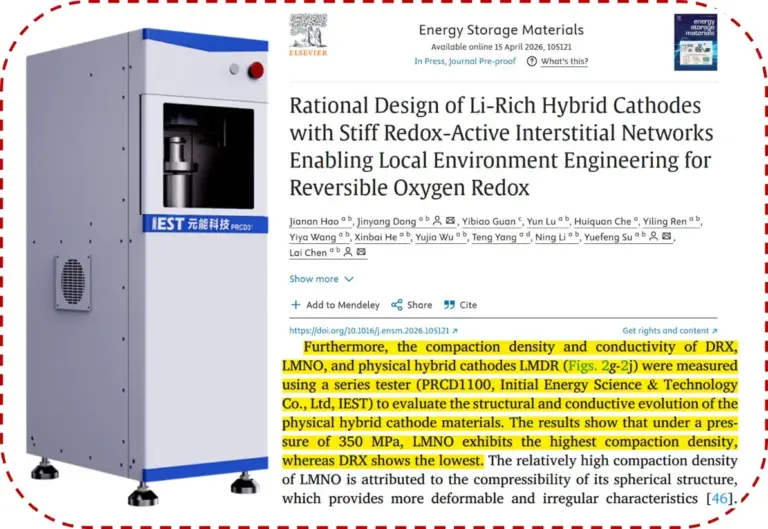
Composite image showing the Nano Materials Science journal article header titled "Pressurized vs. unpressurized LiFePO4 batteries" by Wang, Yan et al., the acknowledgments section thanking IEST Instrument (Initial Energy Science & Technology Co., Ltd) for support, a schematic diagram of the powder resistivity and compaction density measurement setup, and a product photo of the IEST PRCD3100 system

Abstract A recent study published in Nano Materials Science by researchers at Beijing Institute of Technology systematically investigates how mechanical pressure regulates interfacial stability and failure mechanisms in LFP/graphite battery. Comparing cells cycled at 0 MPa (unpressurized) and 0.1 MPa (pressurized), the study found that moderate pressure…

IEST Instrument and Nanoyang at Tianjin University Establish Joint Laboratory for Advanced Battery Research

IEST Instrument and Nanoyang at Tianjin University Establish Joint Laboratory for Advanced Battery Research

Abstract Tianjin, March 23, 2026 — The Nanoyang research group at Tianjin University and IEST Instrument (Xiamen) jointly announced the official launch of their Joint Laboratory at a ceremony held on the Tianjin University campus. The event brought together distinguished experts from across China’s new energy materials community, including…

Distribution of Relaxation Times (DRT) Analysis: High-Resolution Deconvolution of Overlapping Electrochemical Processes in EIS

Nyquist plot showing apparent single semicircle that is actually composed of multiple overlapping semicircles, alongside the corresponding Equivalent Circuit Model (ECM) fit and the Distribution of Relaxation Times (DRT) spectrum that resolves each process into a distinct peak - illustrating the Nyquist-ECM-DRT relationship

Abstract Distribution of Relaxation Times (DRT) analysis is a mathematical deconvolution technique that converts electrochemical impedance spectroscopy (EIS) data from the frequency domain into a time-domain distribution function \(\gamma(\tau)\)— separating overlapping electrochemical processes into distinct peaks based on their characteristic…

Quantifying Longitudinal Binder Distribution in Battery Electrodes: High-Precision Layer Profiling via Automated Electrode Powder Scraping System

In-situ laser metrology thickness curves mapping lithium battery electrode coating profile consistency before and after automated 10 micron scraping layers.

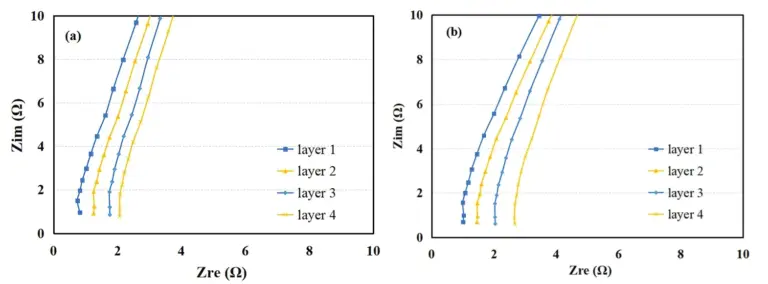
Abstract Longitudinal binder migration during the drying process creates compositional stratification that directly impacts the electrochemical performance, adhesion strength, and cycle life of lithium-ion batteries. Traditional manual scraping methods lack the spatial resolution and depth accuracy required to accurately map…

Electrode Characterization in Lithium Batteries: How to Quantify Electrode Performance Across Uniformity, Wettability, and Mechanical Properties

Schematic showing three electrode uniformity testing approaches — lateral electronic resistance mapping, lateral ionic resistance measurement, and through-thickness thermogravimetric binder distribution analysis.

1. What Is Electrode Characterization and Why Does It Matter? Electrode characterization in lithium-ion batteries refers to the systematic, quantitative evaluation of an electrode sheet’s electrical conductivity distribution, electrolyte wettability, and mechanical integrity to predict cell-level performance. Inadequate electrode uniformity,…

IEST Wechat QR code

Contact Us

Please fill out the form below and we will contact you asap!