Warning: Undefined array key "url" in /www/wwwroot/iestbattery.com/wp-content/plugins/seo-by-rank-math/includes/modules/schema/snippets/class-author.php on line 41
IEST Application Engineering Team

IEST Application Engineering Team

Advanced Energy Materials 2024: IEST In‑Situ Gas Evolution Solution Quantifies Thermal Stability of High‑Safety Solid Polymer Electrolytes

IEST GVM2200 in-situ gas and volume monitoring system schematic — integrating high-precision mechanical testing, dedicated software, multi-function test chamber with auxiliary systems, charge/discharge tester with three-electrode monitoring, and cyclic temperature control — used to quantify thermal-induced gas evolution and swelling behavior of solid polymer electrolyte pouch cells in high-voltage lithium metal batteries.

Abstract Solid polymer electrolyte refers to a solvent‑free or low‑solvent polymeric membrane that conducts lithium ions through segmental motion of polymer chains and typically requires a lithium salt and sometimes a plasticizing agent such as a deep eutectic solvent to…

IEST In-Situ Gas Evolution Solutions Power Major ACS Nano Breakthrough: Quantitatively Reveals Initial Gas Evolution Behavior in Li-Rich Cathodes

Modulating surface anionic redox chemistry toward highly stable Li-rich cathodes with negligible oxygen loss — Xiamen University, Zhejiang University, Argonne National Laboratory research in ACS Nano

Abstract In 2025, Prof. Dongliang Peng and Prof. Qingshui Xie’s team at Xiamen University, in collaboration with Prof. Jun Lu’s team at Zhejiang University and Argonne National Laboratory, published a study in ACS Nano titled “Modulating Surface Anionic Redox Chemistry toward Highly…

Energy Storage Materials | IEST PRCD1100 Validates High Compaction Density & Conductivity in 3D Interstitial Li-Rich Hybrid Cathodes

Rational design of Li-rich hybrid cathode with 3D interstitial network — LMNO layered oxide blended with Ni-based disordered rock-salt DRX particles for reversible oxygen redox

Abstract Li-rich manganese-based layered oxide cathodes (LMNO) are strong candidates for next-generation high-energy-density lithium-ion batteries thanks to their high specific capacity and low cost — but they face compounding failure modes: irreversible oxygen release during the first cycle, transition-metal migration…

Stepwise Pressure Effects on Sulfide Solid-State Battery Interface: How Pre-Pressing, Final Pressing, and Operating Pressure Each Control LPSCl Interfacial Stability

Unraveling stepwise pressure effects on interfacial structure and electrochemical dynamics in sulfide solid-state batteries

Abstract Sulfide solid-state batteries assembly requires three distinct pressure stages, not one. Yan et al. (JCIS 2026) demonstrate that treating “assembly pressure” as a single parameter misses critical interfacial physics. Their optimal three-stage protocol for LPSCl and LGPS electrolytes: Pre-pressing (electrolyte…

IEST SPECT1000 Powers JACS Breakthrough: NJU & CATL Jointly Unveil Graphite Anode Fast-Charging Bottlenecks, Reshaping the Understanding of Graphite Lithiation Kinetics.

IEST SPECT1000 Powers JACS Breakthrough NJU & CATL Jointly Unveil Graphite Anode Fast-Charging Bottlenecks, Reshaping the Understanding of Graphite Lithiation Kinetics.

Abstract Graphite lithiation—the process by which lithium ions intercalate into graphite anode layers during battery charging—proceeds through multiple ordered stage transitions that directly determine the rate and safety of fast charging. A 2026 JACS study by researchers at Nanjing University…

How to Accelerate Battery R&D and Quality Control with Powder Resistivity and Compaction Density Measurement

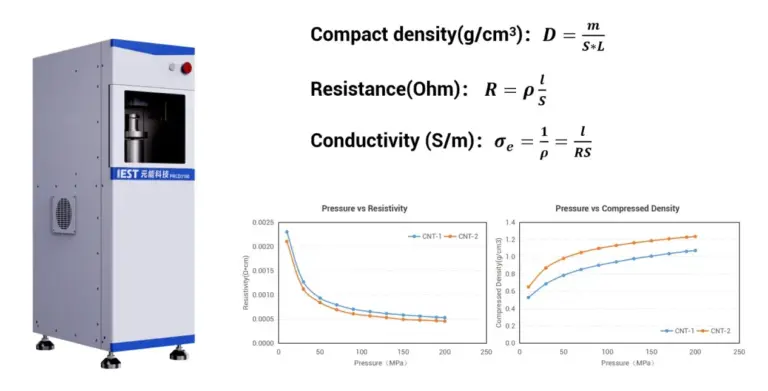
IEST PRCD3100 powder resistivity measurement system and powder density tester setup, featuring the main testing host, customized testing jigs, pre-vibration meter, and demoulding meter for advanced battery material analysis.

Abstract Powder resistivity measurement systems and powder compaction density testers (collectively referred to as Powder Resistivity and Compaction Density, PRCD systems) characterize the electrical conductivity, compaction behavior, and mechanical deformation of battery active materials under controlled pressure. These measurements serve…

Multi-Level Sodium-Ion Battery Testing: A Systematic Characterization Framework From Particle to Battery Cell

Powder resistivity and compaction density measurement comparison for multiple hard carbon anode materials forsodium-ion batteries using PRCD series - showing pressure-dependent resistivity curves and compaction densitycurves for different hard carbon samples, enabling differentiation of material quality and carbonization uniformity between batches and suppliers

Abstract Sodium-ion battery testing requires a multi-level characterization approach covering four hierarchical scales — particle, powder, electrode, and cell — because sodium-ion battery performance limitations originate at each level and propagate upward to cell-level failure. At the particle level, single-particle…

IEST Wechat QR code

Contact Us

Please fill out the form below and we will contact you asap!